Home & Garden
Electric Blanket Costs Cents a Night. Is It Safe to Run?

An electric blanket costs about 4 cents an hour to run. A small space heater costs roughly 15. For the price of one hour of heating a room, you can run the blanket for most of the night, and that is the whole case for the appliance in two numbers.
The second half of the case is the one the retailers skip. A blanket is an electrical appliance, it ages, and fire services record more than 100 fires a year that begin with one. Cheap and safe can both be true at once. The checks in this article are what keep them true.
The cheapest warm in the house
Winter heating numbers are usually depressing, so here are the good ones. Energy Australia’s published guidance puts an electric blanket at about 4 cents an hour, against roughly 15 cents an hour for a small space heater. CHOICE tested blankets across a full season and recorded $11 to $23 for a whole winter on a 92-day season. A single blanket, including nightly pre-heating, came in at about $20 for the season. Even the heaviest pattern tested, one blanket run on low for eight hours a day all winter, topped out around $50.
Those figures are not nothing. Set them against anything else in the house that makes heat, though, and the gap is wide. A blanket warms a person. A heater warms a room, which includes all the air you are not in, the ceiling, and the gap under the door. The blanket is cheap because the job it does is small, and the small job is the one you wanted.
The comparison that decides most household arguments is not blanket against blanket. It is the blanket against whatever else was going to run all evening: the column heater, the panel heater, the reverse-cycle left on for the whole room. Heating one person under a doona is the cheapest version of staying warm that a house contains, and the blanket is the most direct way to do it.
The honest catch is durability. Cheap blankets die young, and a blanket measured in seasons rather than winters stops being a bargain the year it quits. Buy one worth keeping, look after it, and the arithmetic above keeps working for a decade.
That durability point deserves one more line, because it decides the real number. The season figures assume a blanket that works. A blanket that lasts three winters costs a third of its purchase price per winter, and one that lasts ten divides it by ten. The storage habits further down are what make the difference, and they cost nothing but attention.
Do the maths for your own blanket
Three numbers decide your cost: the blanket’s wattage, the hours it runs, and the rate on your electricity bill. The formula is watts multiplied by hours, divided by 1,000, multiplied by the tariff per kilowatt hour. Worked once, at a 60-watt draw and a tariff around 31 cents, it looks like this.
Your tariff is the figure most people guess at rather than read. It is printed on the bill in cents per kilowatt hour, and it is worth finding once, because tariffs differ enough between households to move this sum without the blanket changing at all.
| Your number | Where to find it | Worked example |
|---|---|---|
| Power draw | The label on the blanket | 60 watts |
| Hours a night | Your routine | 8 hours |
| Tariff | Your electricity bill, per kilowatt hour | About 31 cents |
| Cost | Watts multiplied by hours, divided by 1,000, multiplied by the tariff | About 15 cents |
Eight hours at that draw comes to about 15 cents a night. Pre-heat and switch off, and it is smaller again. Either way, the amounts that land on your bill are counted in cents, which is why a blanket is hard to spot on a smart meter at all.
One habit shrinks the number and improves the safety at the same time: a timer, or a pre-heat and switch off. Half an hour of warmth before bed does most of what eight hours of running does for comfort, and it removes the overnight question entirely.
One honest note about the table before moving on. It treats the blanket as running at its stated draw for the whole time, which is the worst case. A blanket on a lower setting draws less, and a timer cuts the hours without touching the wattage. Every version of the arithmetic still lands in cents.
What the fire service says
This is the part worth reading twice. Fire and Rescue NSW records electric blankets as the source of more than 100 fires each year, and its guidance is direct: do not leave a blanket running overnight, and do not leave one on while you are out of the house. The recommended pattern is warm the bed, then switch it off at the wall.
The causes are the ordinary ones. A frayed cord running under a mattress. A controller that has run hot for months. A blanket old enough that its internal elements have stiffened and cracked. None of those failures look dramatic before the night they matter, which is the whole problem with a device that lives out of sight.
None of them arrives without a sign, either. A frayed cord shows its fraying, and a controller that runs hot has been running hot for a while. The checks below exist because those warnings are visible in advance, and a dark bedroom at midnight is the worst possible place to meet one for the first time.
There is a tension in the advice, and it deserves to be stated instead of hidden. Modern blankets are tested to a standard, and some manufacturers do allow overnight use in their instructions. Fire services say no anyway. This article sides with the fire service, on the simple grounds that the blanket is under your bedding, switched on while you sleep, and nobody is watching it.
The advice reads strict because of the setting rather than the appliance. A blanket spends its working life under bedding, inches from a sleeping person, in a room where nobody is awake to notice a smell of burning. Everything else in the house that makes heat is either watched or switched off. The blanket asks for a rule of its own for exactly that reason.
The five-point check before winter

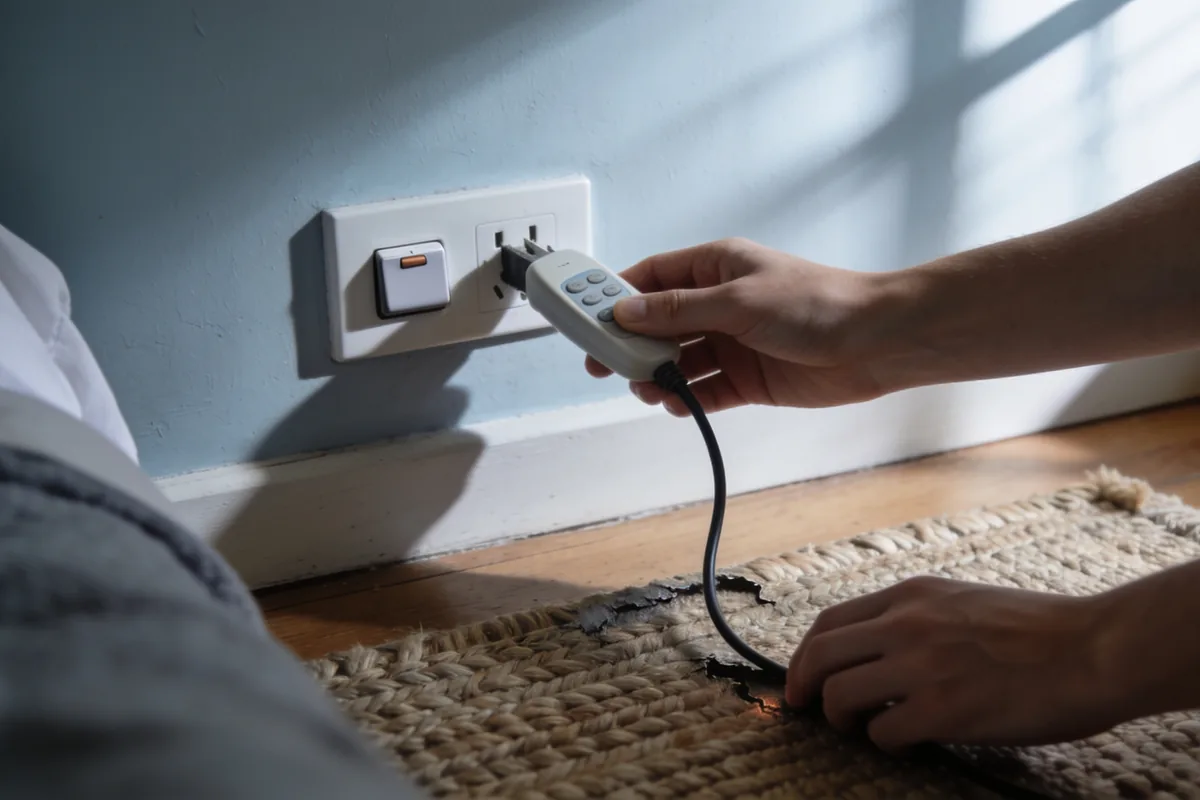
Run the blanket through five checks before its first cold night of the year. Each takes a minute. Any failure takes the blanket out of service, and there is no argument to have about it. Do it on a bright morning, with the blanket flat and unplugged, before the weather forces the question. The point is not to hunt for faults; it is to catch the changes that come before one, and those changes show themselves in daylight far more readily than in a dark bedroom at midnight.
- The cord. Unplug it and run the full length through your hands, flexing gently as you go. Fraying, kinks that stay kinked, or any exposed wire ends the conversation. A cord pinched under a mattress frame is the classic case.
- The plug and the socket. Look for browning or scorch marks on the plug and around the socket it lives in. Warm is normal on a busy circuit. Hot is not.
- The controller. Check that it switches cleanly between settings and off. A controller that runs hot, buzzes, or has a cracked case is a fault, not a quirk.
- The fabric. Lay the blanket flat in daylight and look for scorch marks, hot spots, and patches that have gone stiff or brittle. These are the late warnings, and they are the ones people find after the fire.
- The mark and the age. Look for the regulatory compliance mark and the standard AS/NZS 60335.2.17 on the label. Then think about age. Replace a blanket older than about 10 years, and treat a second-hand blanket as a no.
This is the same logic the site applies to a house’s pipes and wiring, and it is why the plumbing warning signs worth acting on are sorted by urgency rather than by drama. The early signal is the cheap moment to act.
A second check belongs in the same week of the year. The signs a gas leak gives before it hurts anyone are the same lesson in a different system: household appliances fail quietly, and the quiet is the danger.
Storing it is half the job
Most blanket faults are born in summer. Folded tightly around the same creases for months, the fine heating elements inside crack, and nothing announces the damage until the next winter, when one section of the bed stays cold or the controller starts running warm.
Roll it instead. Loosely, along its own length, in a dry cupboard, with nothing heavy resting on top. That one habit adds years to the blanket’s working life and costs nothing to start.
Dust and damp do the quiet damage. Keep the rolled blanket in a linen cupboard or its own box rather than a garage shelf where the seasons get to it, and bring it out in autumn rather than on the first freezing night, when you will be tempted to use it in whatever condition it is in.
Washing runs on the label’s terms, not yours. Most modern blankets can go through a gentle machine cycle, but only when the care label says so and only with the controller detached. Dry it flat, and dry it completely. A blanket that goes into storage even slightly damp comes out with a smell and a question mark over it.
Storage is also where people pass on a blanket they should retire. A blanket that fails one of the checks above does not become someone else’s bargain, and the ten-year rule does not care whether the blanket was expensive, a gift, or a find. A scorch mark, a brittle patch, or a cord fault means it leaves the house finished.
What the meter says
The meter says the blanket is the cheapest way to stay warm through an Australian winter, and nothing in this article changes that. The checks are not there to put you off the appliance. They are there because the same small draw that makes the blanket a bargain sits inside a device that ages in silence.
The savings are real, and so is the ten-year clock inside the appliance that earns them. Run the numbers, run the checks, warm the bed and switch it off. That is the whole method, and it holds for every winter the blanket has left.
One last thing belongs in the drawer with the blanket: a note of the year it arrived, and the receipt if you still have it. The ten-year clock is easier to obey when you know when it started.
Sources: Energy Australia – electric blanket running costs; CHOICE – electric blanket testing and running costs; Fire and Rescue NSW – winter fire safety and electric blanket warnings; Electrical Equipment Safety System – electrical compliance and recalls.