Home & Garden
How to Get Rid of Ants: Why the Spray Makes It Worse

The bench is clean. You wiped it before bed and again this morning, and the bin is not full, and the dishwasher is shut. And still, there they are: a neat line of small dark ants crossing the bench like they are following a road, because they are. You sprayed a week ago, and the spray worked, and now they are back, and it is hard not to hear that as a verdict on your kitchen.
It is not. Ants in an Australian kitchen in late winter are one of the most ordinary events of a household year, and the spray failing after a week is what that kind of spray does. Nothing about the loop you are in is a hygiene problem, and the way out of it is smaller than the effort you have already spent.
What you are seeing

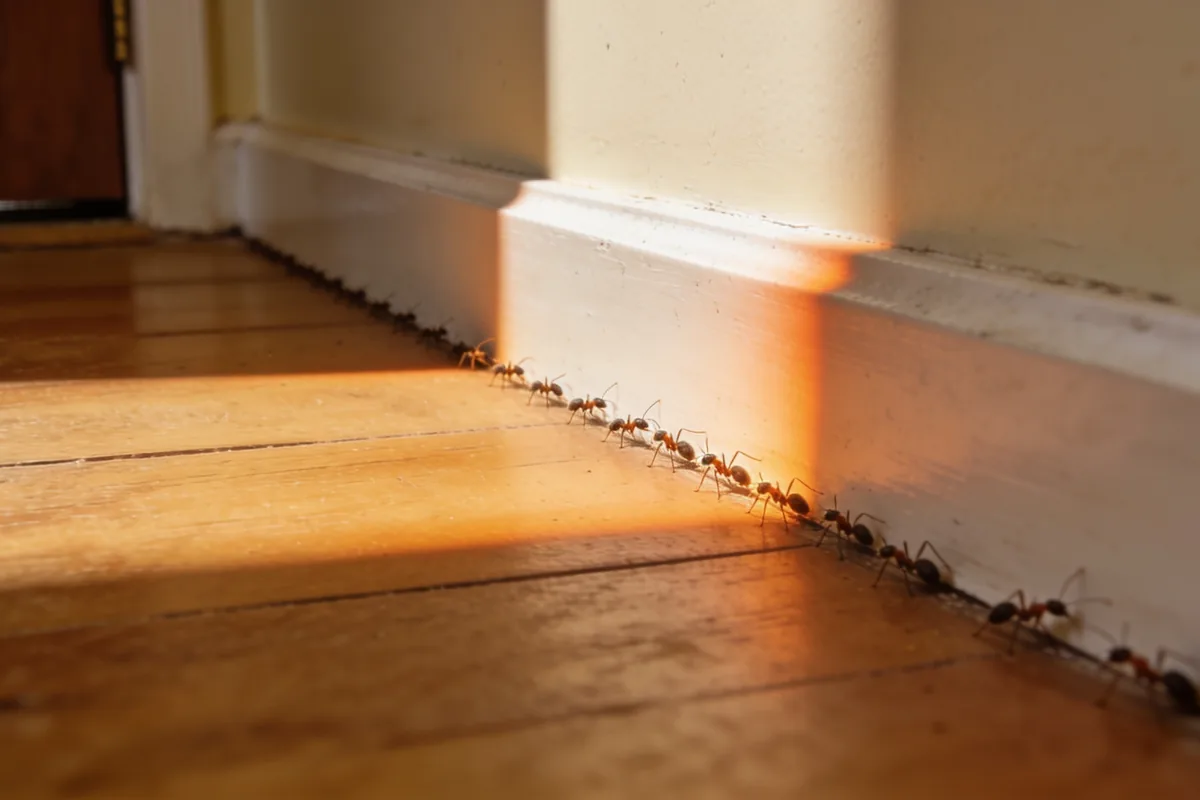
The line of ants is a tail, not the animal. The ants crossing your bench are a small scouting and foraging group, sent out from a colony that can be sitting metres away: in the wall behind the cupboards, under a pot on the windowsill, beneath the paving outside the back door. The colony is the thing with the appetite. The trail is just its delivery route.
This is where the loop you have been in starts. Killing the ants you can see removes foragers and changes nothing about the colony, which has replacements, and the trail reappears as soon as new scouts find it worth running. You are not losing to the ants. You are playing a game that only ever resets.
There is one more detail worth noticing, because it decides how the next fortnight should go. The trail is not random. It is a route the colony has found worth running, discovered by scouts and then reused. Killing the ants on the route does not close the route, and the colony’s response to a closed route is simply another survey. Feeding the route is the only use of it that reaches the nest.
Why the spray makes it worse
Surface sprays kill the ants they touch, and the survivors learn. Contact killers are repellent to the rest of the colony, which is part of how the product works: the treated surface becomes a barrier that ants avoid. That is useful when the goal is keeping ants out of one cupboard for an afternoon, and it is the wrong tool for the goal most people have, which is an end to the traffic.
When a barrier blocks the old route, the colony does not give up. It reroutes, which is why your spray worked for a week and then stopped: the ants are not using the door you closed anymore. Worse, in the ant species with more than one queen, a repellent can split a colony into separate satellite nests, and then you have two problems where you had one. The spray did not fail, in other words. It did what repellents do, and the result looks exactly like failure from the kitchen.
The rerouting explains the specific pattern of your week better than any theory of dirty benches could. Day one: the spray goes down, the ants vanish, and the barrier holds. Day seven: a new line appears twenty centimetres to the left, or on the bench across the room. That is not a new infestation arriving from outside. It is the same colony, having found the way around, and it will keep finding the way around for as long as the way around keeps being the easier option.
What works: the slow feed
Baits work on the opposite principle, and the difference is worth understanding once, because it reframes the whole exercise. A bait is not a poison you hope the colony walks over. It is food, laced with a slow-acting insecticide, and the design of the bait is what does the work.
Ants share food with each other. Workers carry what they find back to the nest and pass it along, mouth to mouth, in a behaviour called trophallaxis, and the food keeps moving from that first carrying ant all the way to the queen and the brood. A slow-acting bait rides the colony’s own distribution system. That is why slow is the feature rather than the flaw: a bait that killed instantly would kill the foragers at the dish and never make it home.
Household baits come in two main appetites, sweet and protein, and different species recruit to different ones. You do not have to know your ants by name to find out which. Put a small dab of each, a hand’s width apart, somewhere along the trail, and watch for two minutes. The ants will gather on one of them, and that is the one to use. It is the simplest piece of evidence you will collect all week.
There is a reason the two-minute test beats every recommendation list: different species recruit to different baits, and which species visits your kitchen is not something a product label can know. Watching for two minutes tells you more about your ants than an hour of reading ever will, and it costs one dab of bait and one moment of attention.
Then the part that asks for your patience. Place bait stations along the trail itself, not scattered around it. Let the ants find them and carry. And leave the whole thing alone for ten to fourteen days, which is how long a colony takes to distribute enough bait to collapse. The traffic may look unchanged for most of that; what moves first is everything you cannot see.
One safety note belongs here rather than in a footnote, because baits are the one part of this article that involves a pesticide. Buy registered products and follow the label, which is written for your jurisdiction and your product; store the stations away from food, and note where they are. The label is not a formality, and it was not written for the ants.
The five rules that decide it
Baiting works when five small rules are kept, and most failed attempts break one of them without noticing.
- Clean away the other food first. Pet bowls and their spill, crumbs in the toaster, the bin’s rim, a stray something behind the fruit bowl. Bait competes with every other meal in the kitchen, and the kitchen usually wins on volume.
- Do not spray anywhere near the bait. Not the trail, not the wall behind the station, not the door frame the ants are using. A repellent beside a bait cancels the bait’s whole premise.
- Keep bait away from kids and pets. Stations rather than open dabs where small hands or a dog’s nose can reach, and follow the label’s directions, which were written by people who know more about the active ingredient than any forum does.
- Mark where each station went. A small note, or a photo on your phone. In two weeks, memory will not be enough, and retrieving the stations matters if the household has pets or small children.
- Change the formulation before you change the brand. If sweet bait has done nothing after a fortnight, the answer is probably a protein bait, not a different label on the same appetite. Two products from one manufacturer that do different jobs beat two brands that do the same job.
The house half of the job
While the bait does its slow work, there is a second, gentler job on the house itself. Ants come inside for the same reasons they come onto a veranda: shelter, moisture, and a way in. Each of those has a small answer.
Walk the outside edge of the rooms where you see them and look for gaps around pipes and cables where they enter the wall, cracks along the skirting, and the soft line where a window frame meets the sill. A tube of sealant closes most of it in an afternoon. Inside, look at the potted plants near the windows and give the saucers a rinse; damp soil in a warm room is a small, dependable invitation.
One more small habit completes the house half. Where you can, follow the outdoor trail back from the house for a few metres. It usually begins at a nest entrance or a crack in the paving, and knowing which one you are looking at tells you within a minute whether this is a fortnight of patience or a conversation with someone qualified. That short walk is the most useful reconnaissance available to a household, and it costs nothing.
The damp itself is worth a thought, because it is the entry condition for the whole problem, and quiet household problems are a subject this site returns to: how to spot a gas leak before it hurts you is the same discipline applied to a different system. You are looking for the quiet condition that rewards early attention, and with ants, the quiet condition is usually a drip or a dark, humid corner somewhere along the wall.
The honest threshold
Some nests are beyond a household’s reach, and it is fairer to say so than to sell you another round of bait. A colony inside a wall cavity, or under a concrete slab, is not a problem that surface treatment solves, because the trail will simply move along the cavity and re-emerge somewhere else. The same goes for the small number of species that genuinely damage buildings rather than merely visiting them; in most Australian homes the indoor visitor is the coastal brown, a nuisance rather than a threat, but identification is a job for someone qualified to do it.
This is the one moment where a licensed pest manager is the sensible call, and it is a call about a nest’s location rather than about your competence. Professional treatment is regulated, and the products a licensed manager uses are registered for the job; that side of the subject belongs to specialist guides. The household’s threshold is simpler: if two weeks of patient baiting has changed nothing, and the trail keeps getting found, the nest is somewhere you cannot reach. That is the site’s usual rule for a house system, the same way the plumbing warning signs that mean it is time to call someone sort themselves by what can still be handled at home and what cannot.
Where the trail ends
One thing to do today, and the rest is patience: put down a sweet and a protein dab, watch which one the ants choose for two minutes, and move the chosen bait onto the trail. Then leave it alone, keep the bench its ordinary level of clean, and give the colony the fortnight it needs.
The ants you are seeing are a small animal going about an ordinary errand, and the ending to this story is dull on purpose. The traffic thins, then stops, and nothing dramatic announces it. You did not win a war; you simply stopped resetting the game and let a slow meal do what a fast spray could not.
There is nothing to feel defeated about while you wait, either. The colony is going about its errand, the bait is going about its slow work, and the household’s only job is to avoid resetting the board for ten days. That is a small thing to ask of a kitchen, and it is the whole of what the fortnight needs.
Sources: Australian Pesticides and Veterinary Medicines Authority – registered bait products and label directions; state agriculture department pest notes on household ant identification and control; CHOICE – baits and sprays guidance for household pests.