Home & Garden
The Washing Machine Smell That Cleaning Tablets Miss

You already own everything this fix needs. The first step costs nothing, it takes no shopping trip, and it is a door left ajar.
Start there tonight. Leave the door open when the load is done, and leave it open until the drum is dry. That one habit changes the conditions the smell needs in order to grow, and it is the smallest of the changes in this article rather than the largest.
If you have already tried a cleaning cycle, a tablet or a splash of vinegar, none of that was wasted effort and none of it is being criticised here. It is the same road most people walk. The reason it has not worked is geography: the products reach the parts of the machine the water reaches, and the smell lives somewhere else.
The order of the checks matters more than the list is long. Start with the gasket and the filter, because those are the two places the smell lives most often, and stop once you have found the source. A machine rarely has five problems at once. It has one problem, showing up in five places, and the first place you find it is usually the whole of the answer.
What the smell is
The musty smell is biofilm. It is a living layer of bacteria and detergent residue, and it builds up on the surfaces your wash cycle never scrubs.
That is the difference between cleaning a machine and freshening one. A hot cycle and a cleaning product work on the parts the water moves across. Biofilm grows in the parts that stay damp and still after the cycle ends: behind the drum, inside the folds of the rubber seal, in the housing behind the detergent drawer.
It also explains why the smell comes back. You kill a layer, the conditions stay the same, and the survivors rebuild. Damp, warmth and food are all a biofilm needs, and a closed machine door supplies all three for free, every night, all year.
It helps to picture where the water rests after a cycle ends. It rests in the low fold of the door seal, in the base of the drawer housing, in the cup of the pump filter, in the low bends of the hose. Every one of those places can be reached and dried, and none of them is touched by a cycle run with the door shut and the machine left to sit. Of the places that hold water, one needs a cloth, one needs a press of a catch, one needs a towel on the floor, and two ask only for the monthly cycle. That is the whole scale of the work.
Where it hides on a front loader

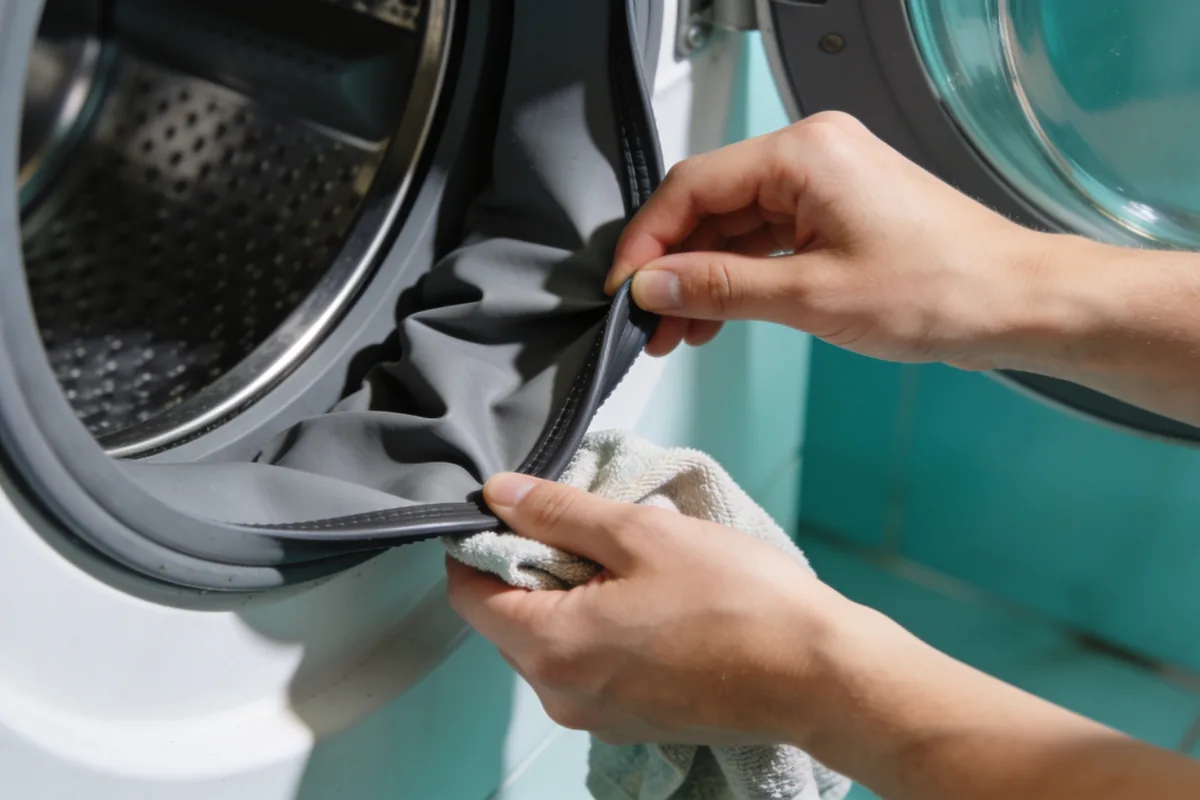
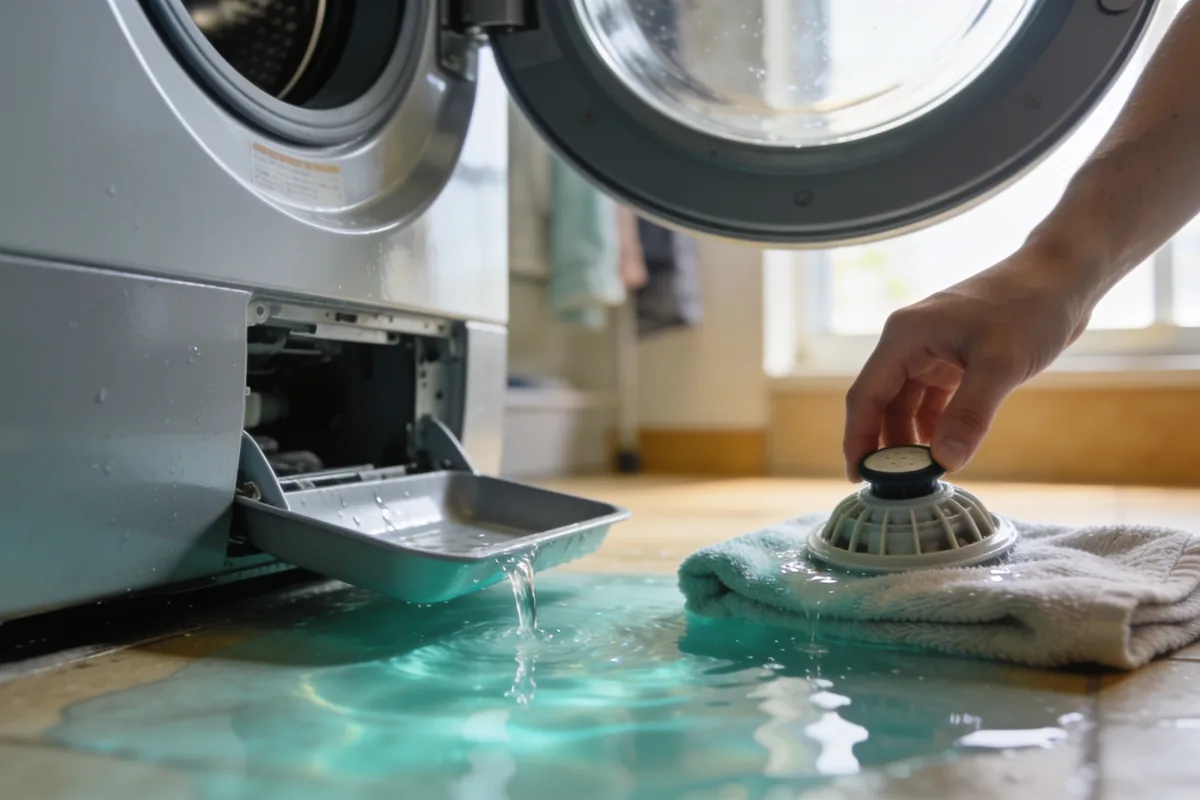
Five places on a front loader carry most of the problem, and each one takes about a minute to check. Start with the most likely culprit, and stop when the smell has an explanation.
- The rubber gasket. Pull the lip of the door seal back, all the way around the drum, and look inside the fold. Water, lint and dark residue collect there, and it is where most smells live. Damp and clean is normal. Slimy or black needs a wipe, and the fold needs time open to dry.
- The drawer housing. Take the detergent drawer out, which most machines allow with a single press, and look into the space it slides out of. Residue sets hard on those surfaces. Warm water and a cloth lift it, and the drawer itself can usually go through a rinse.
- The pump filter. Behind the small flap at the base of the machine sits a filter that catches coins, hair, lint and worse. It turns by hand, and a shallow tray and a towel catch the water that comes with it. This is the check most people never do, and it is the one that most often explains a smell that survived everything else.
- The outer drum. You cannot see it, and you do not need to. It comes clear with the hot maintenance cycle described below, which is what that cycle is for. If a machine has been run cold and gentle for years, this is where the buildup sits.
- The drain hose. The other part you never see, carrying water away at the end of every cycle. A residue film inside it feeds the drain end of the problem, and the same maintenance cycle keeps it in check. A hose that has gone hard or smells at the connection point is a job for a technician, and it is a small one.
If you take one check from this list, take the filter. It is the least glamorous minute in the whole routine and the one most likely to end the mystery.
Top loaders are different
A top loader fails in the same way and hides it in different places. The principle is identical: find the damp, dark, food-rich corners and starve them. The map is shorter, though, which is one small advantage of the design.
Three spots cover most of it. Lift out the lint filter, where the machine has one, and clear what it holds. Look under the agitator cap and around the base of the agitator, where grit and residue gather. Then look into the gap between the inner tub and the outer drum for a tidemark of scum; a fouled gap is an advanced case, and the maintenance habit below, kept up over a fortnight or two, is the honest answer rather than a single dramatic fix.
One more difference between the two designs, and it is in your favour either way. A front loader seals against water with the rubber gasket, which is why it has folds for the smell to use. A top loader mostly does not, which is why its trouble collects in filters and gaps instead. Neither design is cleaner than the other. They simply keep their dirt in different places.
The five things that work
Everything that works is either a smaller change than you expect or a smaller product than the shops suggest. You can start all five this week for almost nothing, and the first two are the ones that matter most.
- Use less detergent. Start at half the cap. Modern detergents are concentrated, machines use less water than their ancestors, and undissolved detergent is the raw material of the waxy residue, called scrud, that feeds the smell. If the clothes come out clean, and they will, half a cap is enough.
- Stop the fabric softener. This is the single biggest change on the list. Liquid softener leaves a residue that the rinse cannot wash away, and that residue is what the biofilm feeds on. Your machine’s manual almost certainly advises against it, and most people are surprised when they look.
- Leave the door or lid ajar. After every load, not just the last one of the week. Air movement is the entire mechanism of this habit, and it is the one the machine cannot do for itself.
- Run a hot maintenance cycle monthly. An empty hot cycle, following whatever your manual directs for maintenance, keeps the outer drum and the hose clear. If the manual names no product, the hot empty cycle alone still does most of the work.
- Dry the gasket after the last load. A cloth around the fold takes seconds. It is the cheapest habit here and the one that pays back fastest.
There is a reason a list of small habits beats a list of strong products, and it is the same reason the site’s guide to smarter cooking with less waste works in the kitchen: systems respond to routines, and a routine a household keeps does more than a treatment applied once and forgotten.
None of the five costs money to begin, and the first two cost less than what you are using now. That is the part of the list worth sitting with. The changes that fix the smell are mostly subtractions: less soap, no softener, nothing new added to the machine at all.
The myths on page one
Three pieces of advice dominate the search results for a smelly machine, and none of them is as wrong as it is incomplete. Each one is worth understanding, because each one explains why somebody tried it and still had a smell.
Vinegar, at a sensible quantity, is a decent descaler for a drum, and it is not a cure for biofilm. The fold of the gasket, the drawer housing and the filter do not soak in a dilute acid cycle; they need to be reached by hand, with a cloth or a brush. Vinegar is also unkind to rubber over time, and the gasket is rubber, so the place that needs the most attention is the place vinegar treats worst.
Baking soda and vinegar together produce a fizz and very little else. The two neutralise each other on contact; the bubbling is chemistry doing exactly what chemistry does when an acid meets a base. It looks like cleaning, and it is a demonstration rather than a clean.
The cleaning tablet is fine as maintenance, and it is not a diagnosis. Tablets work on the drum and the parts water reaches, which is most of what you can see and not much of what you cannot. If the smell survives a tablet, the answer is not a second tablet. It is the map above, worked through in order, starting with the gasket and the filter.
One honest word about descaling products, because they are sold as fixes for this problem and they are nothing of the kind. A descaler has a real job in a hard-water household, and the job is the inside of the drum and the elements around it, where mineral scale builds. It is not a treatment for a gasket fold or a pump filter, because it never reaches them. Use it for what it does well, and let the cloth and the brush handle the rest.
When it is not the machine
Two smells get confused with each other, and they point in different directions. Telling them apart saves money before it saves effort.
A drum smell is musty and close, and it greets you when you open the door. That is the biofilm problem this article is about. A drain smell is sharper, closer to a sink, and it arrives when the machine drains. That one usually comes from the drain or the hose connection rather than the drum, and no amount of internal cleaning will touch it. If the smell appears at the drain end of the cycle, a technician is the cheaper answer than another round of products.
One spare part is worth knowing about, because it changes the arithmetic on an older machine. The door gasket on a front loader is a replaceable part. If the seal is cracked, hard or permanently black, replacing it is a smaller job than replacing the machine, and it restores the one surface the smell likes best.
The dividing line between the two smells fits in one sentence. If the smell arrives with a cycle, suspect the drain. If it greets you when you open the door, suspect the machine. Everything in this article lives on the second side of that line, and the first side belongs to a different trade.
The five-minute reset
The honest ceiling belongs here, because it is kinder to say it than to let a routine promise more than it can deliver. A machine that has smelled for years may not come all the way back. What you can do before spending anything on a replacement is the list above, given a fortnight and one honest look at the filter.
If it still smells after that, the machine has told you something, and the habits you built while checking will keep the next one out of the same trouble from its first week. Door open at the end of the load. Half a cap of soap. No softener. The reset genuinely is five minutes, and you have already read most of it.
And if the machine is replaced after all, start the new one the way you would have ended the old one. Soap at half. No softener. The door open at the end of every load. The new machine deserves the habits the old one taught you, and they cost nothing to carry across.
Sources: CHOICE – washing machine cleaning and maintenance guidance; ABC News – cleaning habits that extend a washing machine’s life (2024); manufacturer care manuals for front load and top load machines.