Style & Beauty
Does Sunscreen Expire? Where You Stored It Matters

The bottle is half full, it cost real money, and it has been sitting in the bathroom cupboard since last summer. Now the first warm weekend is here, you have reached for it, and a small question has stopped you: is this still doing its job? Nobody has ever told you the answer, so the bottle goes back on the shelf while you decide.
Here is the reassuring part first. Most of these bottles are fine, and the four checks below will tell you which ones are not. None of the checks takes more than a minute, none of them requires a chemistry set, and between them they settle the question for every bottle in the house.
There is a second reason the question is hard to answer by feel. Sunscreen does not usually announce its failure. A separated bottle can look almost normal in the middle and slightly odd at the top, and the product’s smell and texture change slowly enough that a winter’s gap resets your memory of them. You are not a poor judge of creams. You are being asked to spot a change you have no baseline for, which is exactly why the checks below are mechanical rather than sensory.
Why sunscreen has a date at all
Sunscreen is not like the other bottles in your bathroom cabinet, and the difference is worth knowing because it explains everything that follows. Products with an SPF of 4 or more are listed therapeutic goods in Australia, regulated by the Therapeutic Goods Administration, and they must carry a use-by date and meet a standard, AS/NZS 2604, for how their protection is measured and claimed. A body lotion can sit in a cupboard for years with nothing but a batch code. A sunscreen has to declare when it stops being sunscreen.
Most sunscreens keep their stated protection for about two to three years unopened, which is the window the printed date reflects. Opened, the clock can run differently: the little jar symbol on the label, marked 12M or 24M, tells you how many months the product is good for after it is first opened. If you are choosing between the printed date and the jar symbol, the symbol is the more honest one for a bottle that has been in use.
The two clocks exist because they are measuring different things. The printed date reflects the shelf life the maker tested, assuming reasonable storage and an unopened container. The jar symbol exists because opening the bottle starts a second countdown: air and contact begin a process the factory had kept paused.
The four checks
Run every suspect bottle through these four, in this order. Most will pass two or three of them comfortably, and the ones that matter are the checks that fail. It is quicker to do the whole shelf at once, so the survivors can be compared against each other.
- The printed date. Look for the use-by date on the bottle or tube, not the batch number beside it. A date that has passed is a plain answer, though it is worth knowing that the date assumes the bottle has been stored sensibly, which the fourth check will return to.
- The jar symbol. Find the open-jar icon with a number inside: 12M or 24M. That is the months-after-opening window, and it counts from the first squeeze, not from the day you bought it.
- The consistency. Squeeze a little onto your hand. What you want is the same cream or lotion it was last summer. What you are looking for is anything that has separated, gone watery or turned gritty, along with any change in colour or a smell that was not there before. These are the signs that matter most, and the next section explains why.
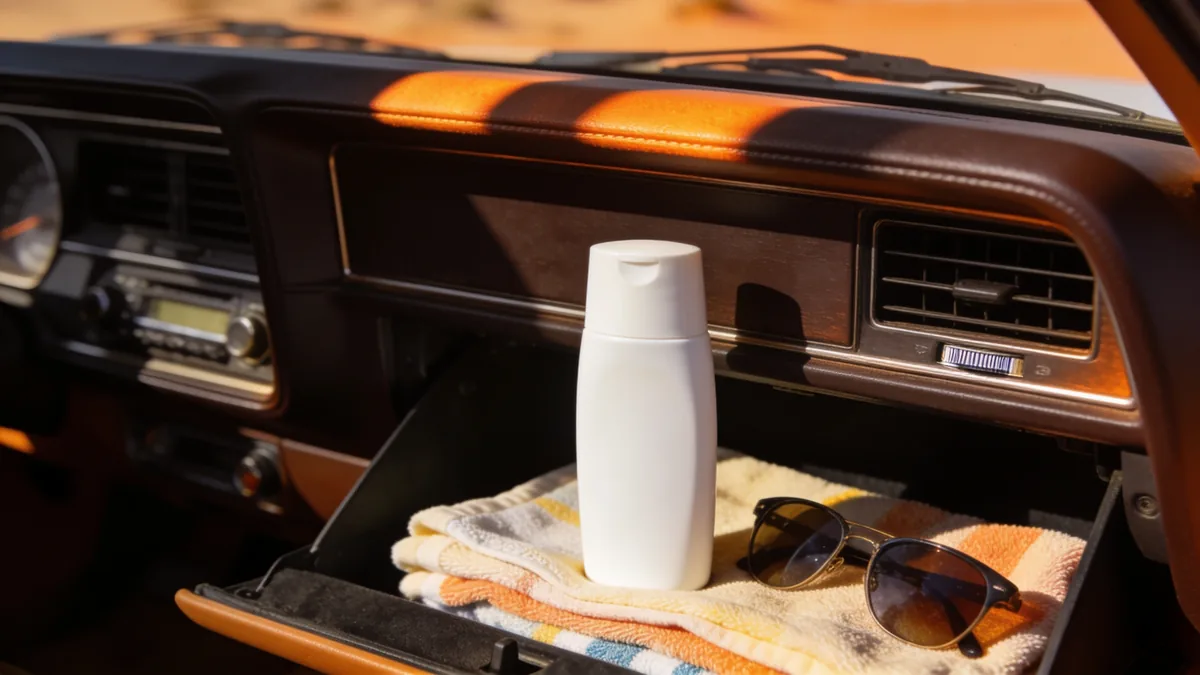
- The storage history. Ask the bottle where it has been. A bathroom cupboard that stays cool and dark is kind to sunscreen; a car glovebox, a boot, a beach bag left in the sun or a windowsill are not. This is the check that can overrule a comfortable date, and it is the one the title of this article is about.
What separation means
Heat is what does the damage, and the way it does the damage is worth understanding once, because it explains why the car is the villain of this piece. A sunscreen is an emulsion: tiny droplets of one thing held evenly through another, the same way a salad dressing is held together until it is not. High heat breaks that structure, and once it breaks, the UV filters stop sitting evenly through the product.
What that means in practice is simple and slightly uncomfortable. A separated sunscreen is not a weaker sunscreen in a predictable way. The protection is no longer spread evenly through the cream, so some squeezes from the bottle may contain more of the filters and some may contain almost none. The number on the label was a promise about the product as formulated, and a separated bottle cannot keep that promise reliably. The regulator has recalled batches over exactly this failure, which tells you how seriously the industry treats it.
This is also why the storage question outranks the calendar question. A bottle within its date that has spent two summers in a glovebox is a worse bet than a bottle at the edge of its date that has lived in a cool cupboard, because the first one has been through the process that degrades the product most. The date is the label’s guess about ordinary storage. You are the only one who knows whether the storage was ordinary.
There is a five-second test for the separation question, and it has nothing to do with the date. Turn the bottle upside down, then back, and watch how the contents move. Ordinary sunscreen is thicker than water and slower than milk; a product that has thinned out, or that shows a clear rim of liquid where the tube has been standing, has already begun the change. If the movement looks wrong, the rest of the conversation is over.
The number that changes everything
There is one figure in this whole subject that reframes everything else, and it is not about expiry. A full-body application for an adult takes about 35 millilitres of sunscreen, which is roughly seven teaspoons, reapplied every two hours through the time you are in the sun. Seven teaspoons, for one person, for one application. A family at the beach on a summer day runs through a bottle faster than most households ever expect.
Which leads to the quiet implication of the half-full bottle. A bottle that has lasted several summers was not being used generously; it was barely being used at all. If your bottle from last summer is still half full after a season, the amount you were applying was likely well below the amount the product was designed around, and replacing it will not fix that on its own. The fix is to buy for the size of the season ahead: for a household that swims and reapplies properly, more than one bottle per summer is normal, and that expectation should shape what is in the cupboard.
The two-hour figure matters as much as the volume, and together they explain why bottles run out faster than households expect. Protection applied at the start of a morning is expected to fall away through the day, and the reapplying is not advice about thoroughness; it is how the product’s stated protection is maintained while you are in the sun. The bottles that last for years belong to households that were not reapplying at all. The checking and the applying turn out to be the same lesson: the label describes a use more generous than most of us practise.
When in doubt
The rule for the borderline bottle is blunt, and it comes from consumer testing rather than from marketing: when in doubt, throw it out. Everything above is designed to shrink the number of bottles that are genuinely in doubt, and a bottle that has passed the four checks has earned its place on the shelf for another season. A bottle that has separated, or that smells wrong, or that spent a summer in the car, has not.
Weigh the two costs for a moment if the throwing feels wasteful. A new bottle is a small, predictable expense. A burn is a week of discomfort with a longer tail, and the person most likely to be burned is the one who trusted a product that had quietly stopped protecting them. The maths is not close, and it is worth remembering the next time a suspect bottle looks tempting.
The habit of checking sits alongside the site’s smaller-daily-habits pieces, and the principle is the same as the signs your gums give when brushing is doing harm: prevention is a routine you keep, not a correction you make once. The same logic runs through the small daily habits that support digestive health, where the results come from the pattern rather than from any single action. Sunscreen belongs in that family, and so does this once-a-season check.
One more kind word for the person doing this audit, because the exercise can start to feel like a small defeat. Nobody keeps a perfect shelf, and nobody was taught the difference between a date and a jar symbol by anything except an article like this one. The point of the check is not the bottles it removes. It is the confidence it gives the bottle you reach for next time, on the morning when the shade is in short supply.
Read the date, then the shelf
The audit takes a minute and settles the whole cupboard at once. Take every sunscreen out, read the printed date, find the jar symbol, shake the ones near their date and look for changes, and think honestly about where each bottle has spent its summers. Keep the ones that pass, and let the ones that fail go without a second negotiation; a quarter-full tube that has been cooking in a car for a year has not earned sentiment.
What to buy for the season ahead comes last, and it is simpler than the shelf it replaces. Choose the protection you will wear in the amount the label assumes, which means buying for real use rather than for longevity, and store the replacements the way the checks have taught you: cool, dark, and out of the car. The date on the bottle is a fact. Where it lives between summers is the decision, and it is yours.
Two small habits keep the shelf honest from then on. Write the month you open a new bottle on the bottle itself, so the jar symbol has a starting date, and keep the spares out of the car, which is where good intentions go to cook. Then the question that opened this article stops being a yearly surprise and becomes a glance, and the bottle from next summer starts its life with an answer already attached.
Sources: Cancer Council Australia – choosing and using sunscreen; CHOICE – can your sunscreen expire, and the discard rule; Therapeutic Goods Administration – sunscreen regulation and product recalls.



 Healthcare1 year ago
SIL Providers: What to Compare Before You Commit
- Healthcare1 year ago
What Is Physiotherapy?
- Healthcare1 year ago
What a Dental Implant Replacement Costs in Melbourne
- Food1 year ago
Budget Bites: Delicious Meals You Can Cook for Under $10
- Healthcare1 year ago
What Changes When You Start SIL
- Tech1 year ago
Mental Health Apps and Wearables: What to Trust
- Home & Garden1 year ago
Gutter Upgrades Worth Doing Before You Sell
- Healthcare1 year ago
How to Put NDIS Community Participation Funding to Work