Pets & Animals
Why Do Dogs Eat Grass? Usually, Nothing Is Wrong

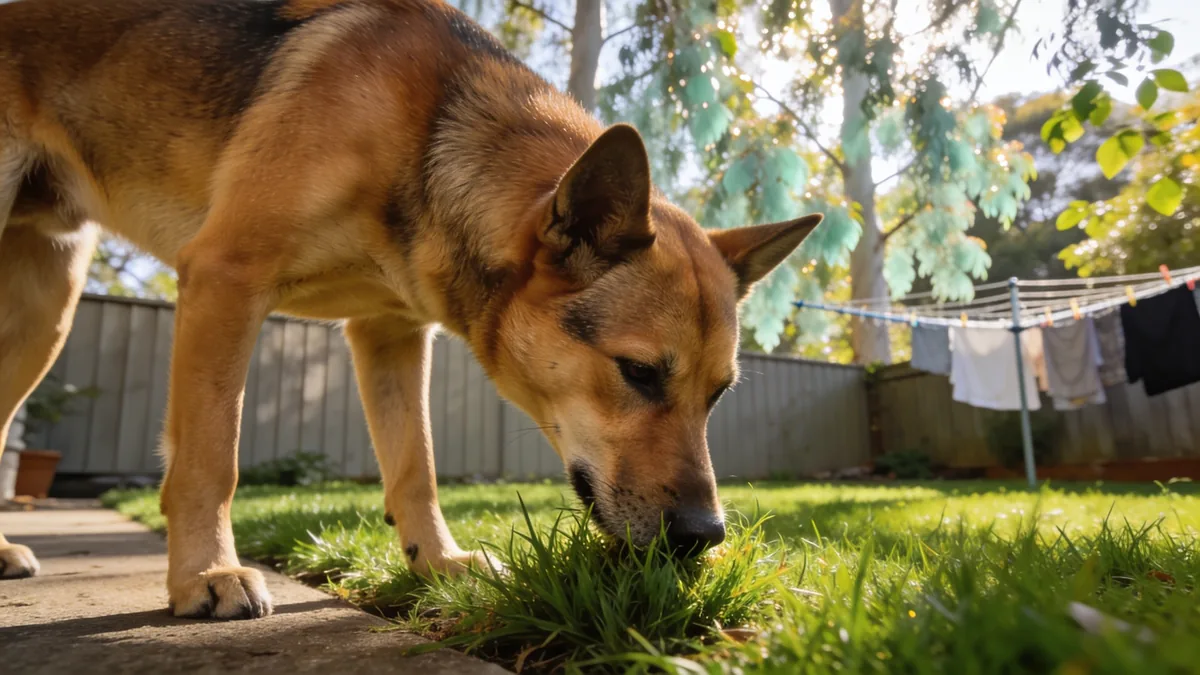
The dog works its way along the fence line like a small, serious grazier, head down, jaws busy, choosing the tufts that are long enough to be worth the effort. At the back door, coffee in hand, someone watches and wonders. Is this normal? Is something wrong? Should the bowl have been filled differently, or the vet have been called, or the patch of grass at the fence have been dug up years ago?
The short answer arrives first, because it is the true one: the odds are strongly in favour of nothing being wrong, and this piece is written for the smaller number of cases where the habit is worth a second look. What follows is what the evidence says, which turns out to be more interesting than either the worry or the older folklore.
How common it is
Start with the scale, because it shrinks the worry to its proper size. When researchers surveyed more than 1,500 dog owners about their animals’ grazing habits, 68 per cent reported their dogs ate plant material daily or weekly. Grass eating, in other words, is not a symptom or a quirk or a failure of the household. It is what a majority of dogs do.
Inside that same survey, the numbers that matter most to an owner arrived in pairs. Only 9 per cent of the dogs appeared ill before eating grass, so the picture of a nauseated animal self-medicating does not match what most of the data shows. And 22 per cent frequently vomited afterwards, with other summaries of the research putting vomiting after grass at fewer than a quarter of dogs and signs of illness beforehand at around 10 per cent. Whatever this habit is, it is not mostly a stomach in trouble.
It is worth saying plainly what those numbers do not mean, because the worry has a way of reassembling itself overnight. They do not mean grass is a balanced part of a diet, and they do not mean every version of the habit is harmless. They mean the behaviour is common enough to be ordinary, and that an owner watching from the back door has joined the great majority of dog households rather than found a problem.
The nausea myth, handled fairly
The oldest explanation for the behaviour is that dogs eat grass to settle an upset stomach, and sometimes to make themselves sick on purpose. It is repeated by everyone, and the studies do not support it as the general case. Across the research, routine grass eating shows no reliable link with clinical illness. The dog at the fence line is not, in most evidence, treating a nausea that nobody else can see.
One nuance deserves its sentence, because it keeps the myth from being dismissed too quickly. Dogs that rarely have access to grass appear more likely to vomit after eating it, which suggests the unaccustomed stomach treats the grass as the irritant rather than the cure. For a dog that grazes routinely, the habituation seems to run the other way. The exception proves the rule: sudden grass eating by a dog that never touches the stuff is different from the daily habit of an old hand.
The answer with the best evidence
The explanation with the strongest support behind it is also the plainest one: hunger and fibre. An Australian study from the University of New England, published in 2007, found that dogs were more likely to graze before their meals than after them, and that the behaviour reduced when the diet was given more fibre and split into smaller, more frequent meals. The study linked excessive grass eating to the two forces that a body uses to say feed me: an appetite and a gut looking for roughage.
That reading fits what the species is. Dogs are omnivores, and plant material has always been part of what a dog eats, which is why the appetite for grass is unremarkable in itself. The practical version of the finding is short: if a dog makes a habit of the lawn, the first thing to look at is the bowl. Is there enough fibre in what goes into it, and does the day’s food arrive in portions that leave long gaps? A dog that grazes on the way to dinner is often a dog whose dinner could be arranged differently.
Which gives the habit a use that the folklore never mentions. Grass eating, read correctly, is information: a dog telling its household something about the state of its appetite on that day. The skill is in reading the message rather than in stopping the messenger, and the reading is easier than it sounds.
The one skill that matters: grazing versus frantic
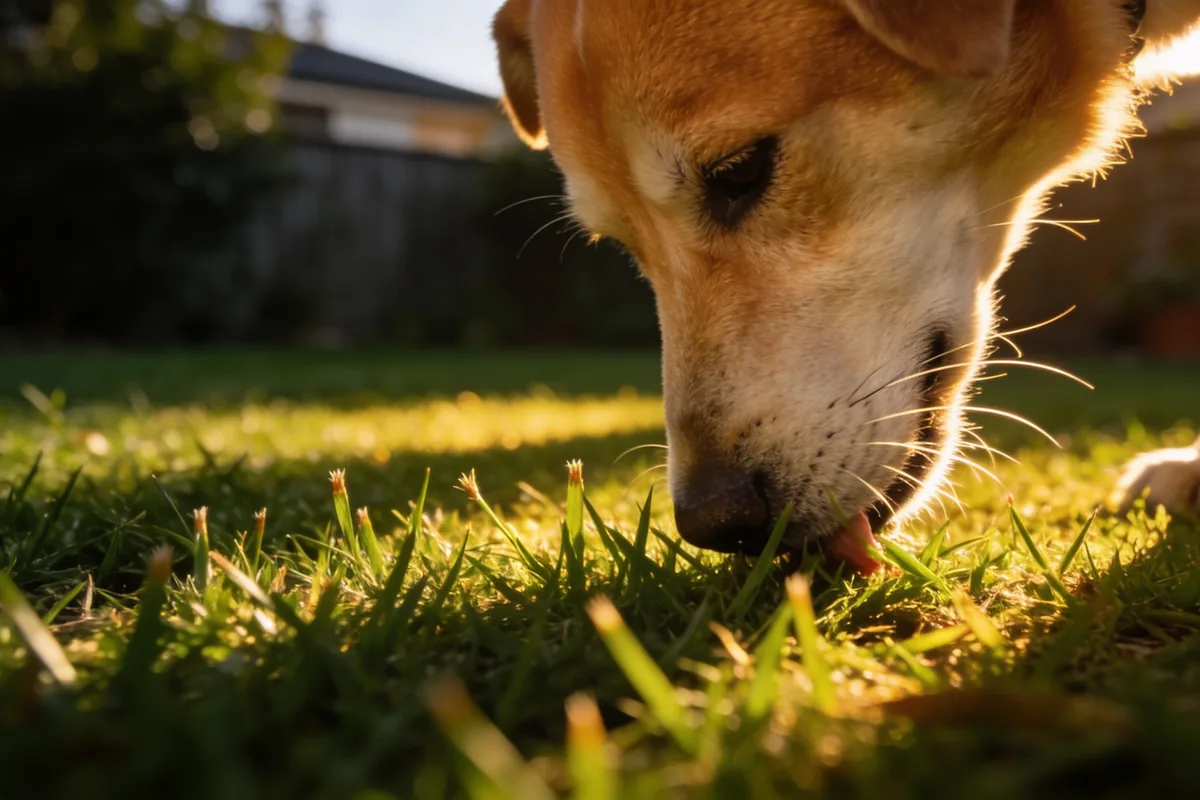
Owners who live with serious grazers tend to arrive at the same distinction, and it is the most practical thing in this article. There is casual grazing, where the dog takes the odd bite while pottering around the yard, as unhurried as it is pointless. And there is frantic eating, where the dog tears at the grass in strips, swallowing quickly, as if it is starving or desperate to get something down.
The two patterns mean different things, and the difference is worth learning in the way you learn a household sound. Casual grazing is almost always the fibre-and-habit version described above, and it needs nothing more than the bowl adjustment. Frantic eating is the pattern that suggests a stomach genuinely in discomfort, and it is the one worth mentioning to a vet if it repeats. Same behaviour, different message, and the message is in the pace.
When it is worth a vet visit
The trigger for professional advice is not the grass itself but everything travelling with it. Frequency is the first signal: an occasional habit is a habit, while a sudden change to constant grazing deserves a conversation. The other signs are the standard ones for any digestive change: repeated vomiting, diarrhoea, weight that moves, an appetite that changes, or a dog that seems flat rather than interested. Any of those alongside the grass is a reason to ring the vet, and the conversation is about the pattern and the animal, not about the lawn. Bring notes rather than a vague sense of worry: when the grazing happens, what it looks like, and what has changed this week. A vet can do more with a week of observations than with a feeling that something is off, and the observations take a minute a day to collect.
Two practical cautions belong with it. First, a dog that swallows large volumes of long grass quickly can take too much into the gut at once, and in rare cases the result is a blockage that needs surgical attention, so the frantic pattern is not merely a worry about manners. Second, the grass itself is not always neutral: chemically treated lawns are a risk for any dog that grazes, and regular grazing on grass shared with other animals increases exposure to parasites. RSPCA Australia’s guidance points owners towards grass that has not been treated and a watchful eye on changes in the pattern, which is the calm version of both cautions.
None of this is veterinary advice, and it is not meant to be. It is the shape of the decision an owner makes: watch the pattern for a week, act on the changes, and let a vet weigh what the watching cannot. A digesting dog needs the professional eye for the same reason a person sees a doctor rather than a search page, and the earlier that eye is involved, the smaller the conversation tends to be.
The bowl before the lawn
The fix, where a fix is needed, starts away from the grass. Fibre up, in whatever form suits the dog and the household, and meals smaller and more frequent rather than one or two large servings. Watch the pattern for a week after the change, and note whether the frantic version has calmed into the casual one; that change, if it comes, is the evidence the bowl was the right place to look.
The site’s other dog piece, on rope toys that survive a determined tug of war, comes at the same subject from the other end: what a dog does with its mouth is a need the owner can channel rather than a problem to be policed. Grass belongs to the same appetite, and most of the time it wants the same treatment as the rope: nothing dramatic, just a sensible household and a watchful eye.
So let the dog finish its round of the fence line, and go and look at the bowl instead of the lawn. The odds say the grazing is ordinary, the evidence says it is usually about fibre and appetite, and the one thing that should pull you back to the door with the phone in your hand is a change in the pattern rather than the habit itself. The lawn was never the problem. The bowl is where the answers live.
Sources: RSPCA Australia – dog behaviour guidance on grass eating; University of New England (2007) – study linking grass eating to hunger and dietary fibre; UC Davis-led grass eating survey and VCA Animal Hospitals summary (the 68 / 9 / 22 per cent figures and the under 25 per cent vomiting line).
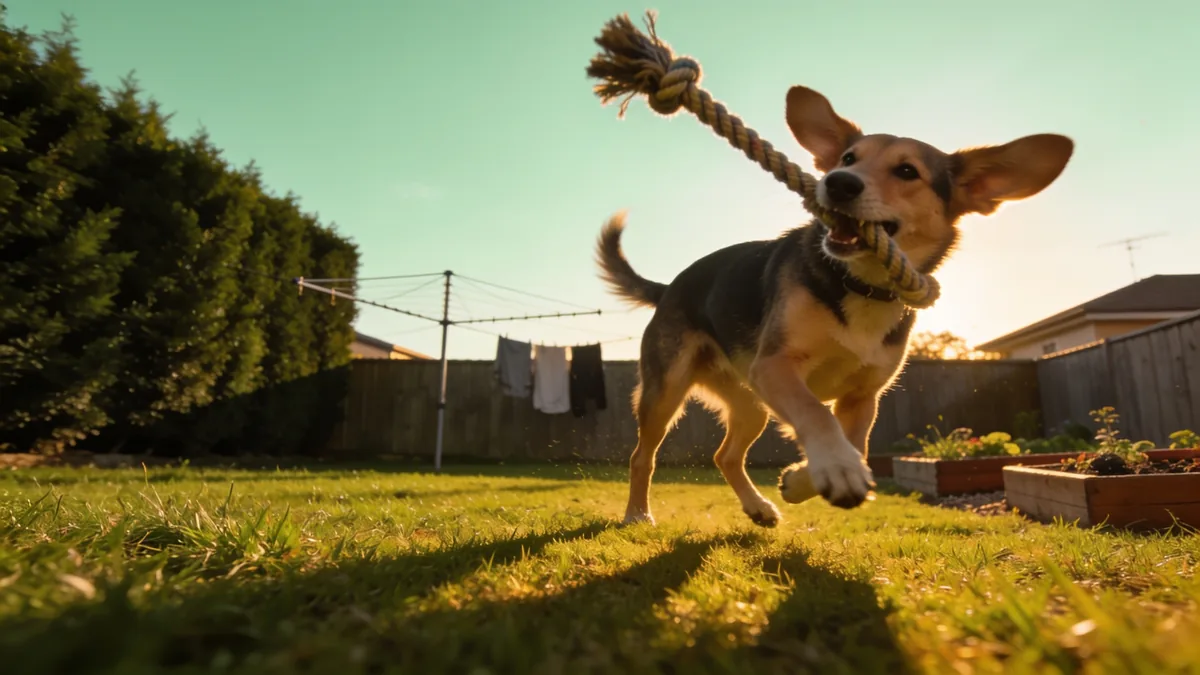
The rope comes out of the basket and the dog is already braced, front paws wide, tail going like a metronome. Tug-of-war is the game most toys were not built for, and a rope toy that survives it is a small piece of engineering: the right fibre, pulled tight, knotted properly, and retired on time.
The ropes that fail, fail in ways you can see coming. A shopping list of what makes one last is below, along with the point where a good toy turns into a hazard, because both matter in the same game.
What the rope is made of
Natural fibre is the safer base. Cotton and hemp ropes tend to fray into softer strands than synthetic rope does, and a strand that comes away is the beginning of the problem either way. What matters more than the fibre is the twist: a tight, dense braid holds its shape under a hard pull, while a loose weave opens up in a week and starts shedding.
Look at the ends before you look at the label. Finished, tightly knotted ends stay finished; a rope whose ends are already fraying in the shop will be worse by the weekend. Check also for a plastic core or a squeaker buried inside, because those are the parts that end up in pieces once the outer braid gives way.
The weave and the knots
Dogs grip near the knots, so the knots are where the toy either holds or fails. A properly made rope toy has knots that are tight enough to feel like a single lump, and ends that have been finished rather than merely cut. If the knots start to loosen, you can usually retie them and get more life out of the toy; if the braid itself is separating, the toy is done.
Matching the toy to the dog
Size is a safety feature, not a style choice. A rope meant for a small breed disappears into a large dog’s mouth with the ends at the back of the throat, which is how strands get swallowed. Buy for the dog on the end of it: thick rope for large jaws, and nothing so small that more of it lives in the mouth than in the hands. For a dog that tugs off the floor, a rope that is long enough to keep a grip away from the teeth is the one that lasts.
Play style decides the rest. Tuggers need dense, unsoftening rope. Fetchers will find that a wet rope hits the ground like a sandbag, so rope is not the best second pick for a beach dog. And the committed chewer needs a different toy entirely, because a rope is built to be pulled, not dismantled, and the dogs that treat it as a demolition project are the ones most at risk of swallowing fibre.
The dental claim, handled honestly
Rope toy packaging often suggests a flossing effect, and there is something to it: the gentle abrasion of cotton against the teeth can slow the buildup of plaque. It is a small help and not a substitute for brushing, dental chews or the vet’s scale and polish. Treat it as a pleasant side effect of play rather than a dental plan, and keep the actual dental plan.
The safety rules
Supervise the game. That is the whole of the safety instruction, and everything below is detail attached to it.
- No rope toys left in the bed or the crate. A bored dog and a frayed rope are a swallowing risk when no one is watching.
- Watch for strands leaving the knot. A rope is finished the moment its braid starts unravelling, not when it looks tired.
- Know the signs of trouble. Vomiting, drooling, refusing food or a change in toilet habits after a heavy chew session are reasons to call a vet the same day.
- Wash the rope like a kitchen sponge, because it collects what the kitchen sponge collects. Hot water, no fabric softener, and dry it properly before it goes back in the basket.
- Rotate the toys. A rope that disappears for a fortnight comes back interesting, and the basket lasts longer.
When to retire a rope toy
The test is simple. Pick the rope up and look at the ends and the knots: if the strands are separating, if the core is showing, or if a knot has gone slack more than once, the toy has moved from equipment to hazard and belongs in the bin. Retiring a rope a week early costs a few dollars. A swallowed strand costs a vet visit and a very bad night, and the dogs most likely to swallow one are the ones enjoying the game the most.
A rope that is washed, re-knotted and kept in play until it is genuinely spent is the same habit as keeping anything else in the house in good use until it is done. The kitchen version of that habit is the busiest example of it on the site.
Where it fits among the other toys
No single toy covers a dog’s week. Rope does tug and comfort chewing. Durable rubber does the heavy chewing. Puzzle feeders work a different muscle entirely, the kind that gets bored, and a bored dog invents its own games, usually with your furniture. A small basket with one or two from each column beats a pile from one.
Choose the toy, then supervise the game
Buy for the fibre and the weave, size it against the dog rather than the shelf, and stay in the room while it is being destroyed for fun. Do those three things and tug-of-war stays what it should be: the ten minutes of the day the dog has been waiting for, and one of the few games where the two of you are genuinely on the same team.
Sources: the RSPCA (rspca.org.au) and veterinary associations publish guidance on safe chew and play practices for dogs; toy manufacturers list materials, care instructions and any safety warnings on their labels.


 Healthcare1 year ago
SIL Providers: What to Compare Before You Commit
- Healthcare1 year ago
What Is Physiotherapy?
- Healthcare1 year ago
What a Dental Implant Replacement Costs in Melbourne
- Food1 year ago
Budget Bites: Delicious Meals You Can Cook for Under $10
- Healthcare1 year ago
What Changes When You Start SIL
- Tech1 year ago
Mental Health Apps and Wearables: What to Trust
- Home & Garden1 year ago
Gutter Upgrades Worth Doing Before You Sell
- Healthcare1 year ago
How to Put NDIS Community Participation Funding to Work